Meadow Mueller 07/2003 - 04/2015

Meadow Mueller 07/2003 - 04/2015

April 21, 2011

I Assure You Spring is Here, or Almost

Here we are going into the third week of April and I, much like many others, are wondering... is it Spring or is it Winter? A couple days near +20c and soon after right back into heavy rains, cold temperatures and even some snow flurry activity.

Yes, it's Canada, this is how things are, deal with it. But we all like to talk about the weather, the good days but more so about the bad days. I always wondered why that was?

Anyhoo, I want to assure you that Spring is here... or almost.

First sign for me was the return of the Red-winged Blackbirds back in mid-March. Most Robins don't fly south anymore, so never mind what we were taught as children about them being the sign of Spring in this day and age.


And speaking of Robins. I was feeding a pair last April and May whom have which returned this April and I am feeding these two in the same spot on the ground (near my swing) as I did last year. I am 110% certain it is the same pair. Two weeks ago I went outside and there was a Robin on a branch above my swing making a lot of ruckus. I was hoping they'd return and bought a small container of roasted mealworms the first weekend of April. I went inside, got the worms, set them near the swing post and in seconds he was down on the ground and having himself a good feed.

Here is Mr. Robin having himself a feed.


Here is Mrs. Robin waiting to get a helping herself.


I never really gave Robins much thought in my life. Sure, they are cool birds. But so common. After spending nearly 2 months last Spring watching this pair, I found some new admiration for them. I enjoyed watching them hunt more so than anything. They'd run a couple feet, stop suddenly, remain still, run a bit more, and do the same thing over and over until they found an insect or worm. Now with this pair returning for a second year... they just might make the 2012 backyard calendar.

Other great sightings in recent weeks include Golden-crowned Kinglets, Black-crowned Night Herons, Tree and Barn Swallows. But I suppose the most exciting for the birder people is the word "Warbler". On April 18th, I saw my first Warbler for the year. A Yellow-rumped Warbler! And now I have seen two this week in different areas of Toronto. There are so many Warblers that pass through Toronto at this time of year, it's mind blowing. To see them, one is quite fortunate. They are small birds who seldom sit still.

Here's the first Yellow-rumped I saw.


Here is one of many Golden-crowned Kinglets I have seen lately. They are much like the Warbler in the fact that they are a very small and quick moving bird.


Other signs of Spring I have witnessed are the nests well on their way with our feathered friends.

The most exciting for me is a pair of Eastern Screech Owls who are nesting very close to my home. While I can't see mommy and the eggs; I often see daddy sitting near the nesting cavity resting through the day.


A pair of Red-tailed Hawks are nesting a little north of home too!


Some days there is a lot of activity around that nest!


And right in our own backyard, a pair of House Sparrows are nesting in one of our bird houses. The same house a pair of Chickadees nested in a few years back. While we hoped for Chickadees again, almost anything is acceptable for us.


Before you are convinced... here are some signs of a lingering Winter such as these this week.

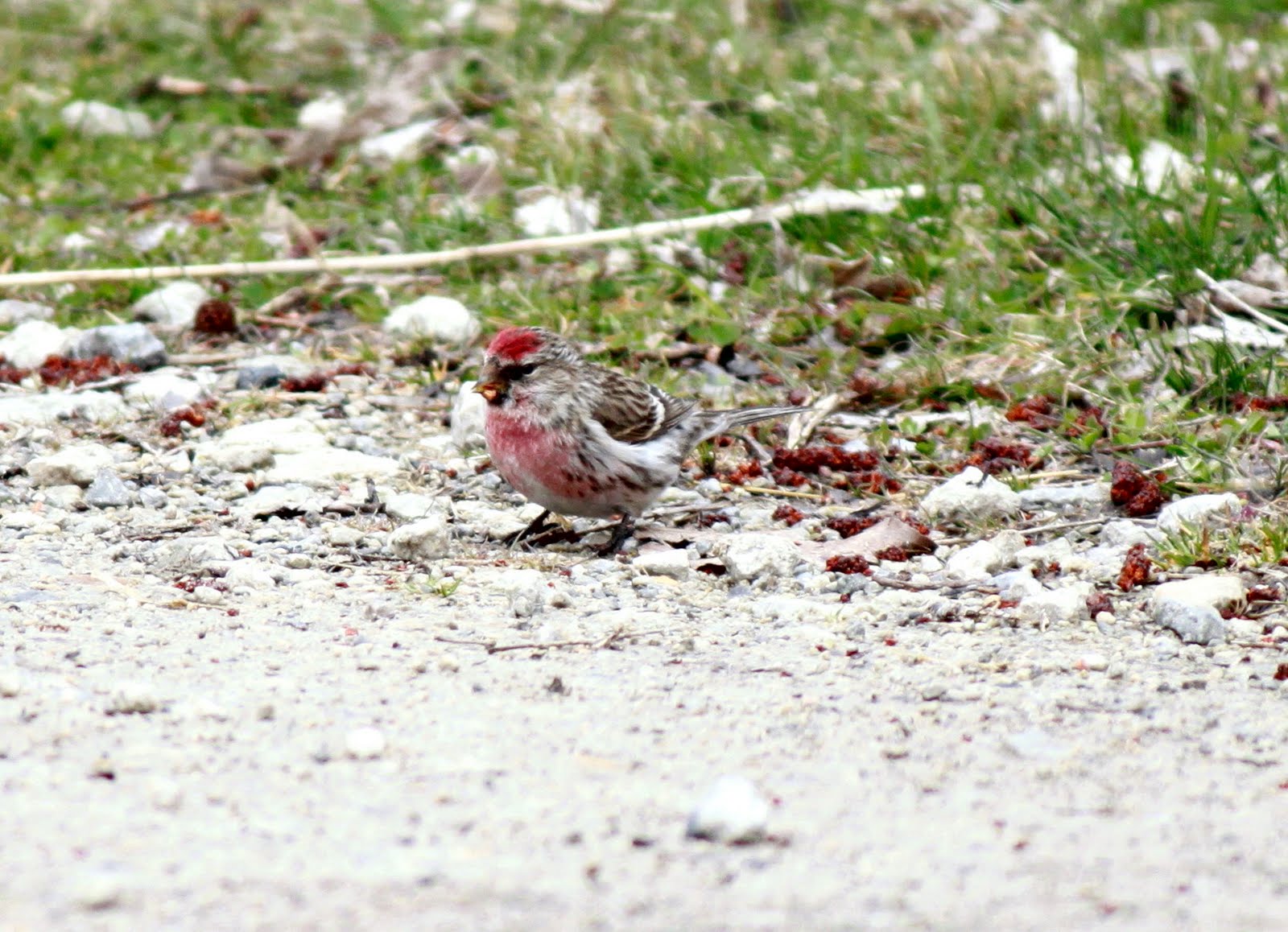
I saw four Common Redpolls on April 18th down at Humber Bay East Park. A bird who should be very north of us now yet was seen right along the shores of Lake Ontario.


This female Red-winged Blackbird sure shows some signs of disapproval of the falling snow on that same day (the 18th) in the same park.


So, what do you think? April can be a fickle month, we should expect that. Let's just hope May is much better. What's the saying? April showers bring May flowers? Not sure how it goes when it's April snows...

March 23, 2011

The Butcher-bird of Colonel Sam Smith Park

Rain rain, go away, come back again another day. Anyone been reciting that poem in their head this month? Environment Canada correctly predicted the cold wet Spring we are experiencing. I once read that a person who would sing the "Rain rain..." poem in whatever culture, of course many years ago, would be frowned upon at the very least, as this is a wish for drought. Now moving on from my half-assed Cliff Claven (CHEERS mailman) moment of an incomplete useless fact...

A rainy Friday morning, May is almost done, and I have been thinking about the many new birds I have seen this year. Spring has been mind blowing with 20+ species to add to the life list in my head. And this past winter brought me a few too.

A long over-due moment I want to share is my sightings of a Northern Shrike.

My first time seeing the Shrike and photographing him at Col. Sam Smith Park in February 2011.


After some time of Angie and I getting into this world of birds/birding, I learned of this killer songbird. I am not using slang here, he is a songbird and yes, he is, a killer. While I love all life forms and have no desire to watch any predator catch his prey; I have had some fascination with this bird. And the fact that he is considered a songbird really threw me for a loop! Imagine that, a songbird, a bird in the mind of most, is a pretty little cheerful bird who can brighten up a person's day with their lovely song is in fact a meat eater, a killer of flesh!

So for over five years I have thought about this bird. I have searched out Northern and Loggerhead Shrikes in various parts of Ontario. This past winter some reports were coming in of a Northern Shrike at a local waterfront park. I thought finally there is a chance to see one. Seven trips over nearly a month finally had me seeing him. I probably had about five minutes of looking at him through my binoculars from a distance and would take a few steps, take a photo, watch him, and repeat the process. I was in awe and unfortunately I was alone. Angie was home unwell and missed this lifer moment for me... a bird I have REALLY wanted to see for so long. Mind you, I am not a jump up and down, and hip hip hooray kinda guy; but I am certain my excitement and joy within beamed out through my smile as I watched this bird.

A week later it was the "Great Backyard Bird Count" and Angie and I were trekking out to a number of spots west of us to participate. Our last stop was to be Col. Sam Smith and sure enough there was the Shrike in full view as soon as we hit the trail. This was Angie's lifer moment with him. So it was great to see him once again. But this time there was an added treat to the viewing. He began to go through some funny motions as he sat in this tree, opening his beak wide every so often, until finally he expelled a pellet. How cool (and gross to some) is that?!?!

A moment in the Shrike's pellet expulsion.


If you don't know what a pellet is. I will brief you. This Shrike will eat smaller birds and mammals. Since Shrikes do not have teeth, they can't chew their food. Therefore, they use their strong and sharp beaks to rip their prey apart and then swallow large chunks whole. The Shrike slowly digests its meal by separating the softer materials (such as meat) from the harder material (such as bones). It then regurgitates the harder material along with indigestible items such as feathers and fur in the form of a pellet.

A more comfortable moment with the Shrike after the pellet is gone.


It's now March, Spring is nearing, and I know this guy is going to be migrating to the north soon. I am also uncertain if he will return next winter or not. So I take advantage of some more pleasant sunny afternoons and seek him out again after a work day. And once again I am blessed with yet another new experience with this bird. Mating season is on the horizon and this guy has suddenly become very vocal. He is singing his rather strange song out to the world in hopes to attract a female. Word around the area is that there in fact were two Shrikes in this park; but I only saw the one. I haven't read up on sexing them and will probably leave that for next winter (if they return).

Here he is enjoying the warmer sunny afternoons of March 2011.


With his singing his song quite often, he was found much of the time in some lower bushes near the marina. I was able to get quite close to him through these days and after some fighting with the camera due to the thick brush and focus problems, I got me a couple decent pics of him right up close. You are able to see the serrated beak which he uses to tear apart his meals. I never saw him eat but these three moments I have described here sure make it feel like I had three firsts with one bird that I really wanted to see in my life.

Next year I hope to have an opportunity to video record him and his song. But seeing him up so close like this, hearing his song, on my final visit with him is a lifelong memory.

Look at this pretty little killer! The Butcher-bird of Colonel Sam Smith Park.


Some of the shots are heavily cropped. I never knew how close I could get with this guy so I would start photo'ing from a distance. And some days with it being in the -20s sure didn't help the trigger finger.

March 9, 2011

Walking in the Woods

I was walking in the woods, and what did I see? A little Eastern Screech Owl trying to have a sleepy. Are you humming along now?


Okay, seriously... a really cool sighting on one of my walks in some woods within the GTA! I don't know much about these little Owls though so here's some tid-bits from Cornell Lab of Ornithology.

* The Eastern Screech-Owl eats a variety of small animals. Two captive males ate from one-quarter to one-third of their own body weight in food each night, but sometimes skipped a night and stored food instead.

* The trilling song on one pitch, sometimes known as the Bounce Song, is used by members of a pair or a family to keep in contact. The male will trill to advertise a nest site, court the female, and when arriving at a nest with food. The descending Whinny is used in territory defense. The songs usually are uttered separately, but sometimes are heard together.

* Eastern Screech-Owl pairs usually are monogamous and remain together for life. Some males, however, will mate with two different females. The second female may evict the first female, lay her own eggs in the nest, and incubate both clutches.

* The Eastern Screech-Owl is known to eat a variety of songbirds, including the European Starling. Despite this fact, the starling regularly displaces the owl from nesting sites and takes over the hole to raise its own brood.

As you can tell from my photos, these Owls, like many others blend in very well with their environment. A really tough one to spot out in the wild. He's probably 30 to 40 ft up the tree.


Standing next to a tree, one probably wouldn't even notice this guy above them.


So, if you really would like to see one but don't have the time to search, the patience to search and a bit of luck on your side as well... I suggest visiting Mountsberg Conservation Area and their Raptor Centre. They have 3 Eastern Screech Owls in captivity. All of which are unreleasable for one reason or another.

Meet Echo in these shots...


And if you are willing to pay for a personal Raptor Encounter, and behave yourself, showing respect and kindness, you should be able to hold one of these beautiful little Owls like I am here with my pal Otis. He looks a tad grumpy, him and his one good eye.

February 9, 2011

Winter Update

Baby, it's cold outside!

Lame intro, I know, but quite true. We've had many days of some serious wind chill factors lately, eh. I enjoy winter. For a wildlife lover such as myself, there is much to see in the city at this time of year that isn't seen through the other seasons. Like what? Lots of different Ducks. I never took notice until a couple Februarys ago when Angie and I noticed Buffleheads down in Port Credit. I blogged about them a while ago... see here

A new one for me this season, although it was just a few weeks before winter, was a couple pairs of Hooded Mergansers. This one sure stands out in the mix of Gadwalls. I don't know much about these guys other than they are cool looking!


A long list can be made of all the water fowl that show up in the GTA every winter including Hooded, Common and Red Breasted Mergansers, Buffleheads, Long-tailed Ducks, Red-heads and a number more that escape me right now. Capturing shore birds with the camera isn't easy as many stay far out on the water. Enjoying them through binoculars if fine by me, just got to dress for the frigid wind temperatures along the lakeshore. It still amazes me that with many of these Ducks, this is their "summer home" as they move a lot further north in our warmer months.

Here's a few of my better photos of the Ducks this winter...

A male Long-tailed Duck


A pair of Buffleheads


Another first for me this year... a Northern Pintail mixed in with some Mallards.


I think they are around the city more than just the winter, but I have never seen one before. What a beautiful Duck!


Perhaps it's just me but I think I have seen a lot more Swans through the winter too! So far it's just been Mute Swans. I do hope to see some Trumpeter Swans like I did last year. Here's a beautiful Mute Swan.


Another first for us this winter is the American Coot!


At home, I have had more Finches this winter than what I have ever seen. Some days I have counted over thirty American Goldfinches. Along with them, I have had over one dozen Pine Siskins present. It's a good thing I have four nyjer feeders for them to eat from.

Here's eight Pine Siskins at the one tube feeder. I guess it's been 3 winters since I last saw them here. So, this was a treat for me to have them despite the amount of nyjer I am going through this year.


The same feeder with as many, and some, American Goldfinches.


A pair of Blue Jays have stuck it out with us this winter. As well as a pair of Northern Cardinals, and one extra male. I am disappointed to only see this many Cardinals. In previous winters I saw 12 out back, which had 9 males and 3 females. A spectacular sight for sure! A lot of Dark-eyed Juncos arrived again this winter (another wintering bird for us). And, happy to say a pair of Red-breasted Nuthatches also returned for the winter. No White-breasted Nuthatches for me this year though... unfortunately (I love those guys). Two pairs of Downy Woodpeckers some days. Half a dozen, maybe more, Black-capped Chickadees. A few Mourning Doves as well. What is surprising is that all the House Sparrows have disappeared. Strange since this is one of the most common birds around. The Pigeon population has taken a huge hit this winter in my backyard as 5 Hawks have been using this spot as their hunting ground once the snow arrived. 2 Red-tails, 1 Sharp-shin, 1 Coopers and the last one being a stumper for me... a toss up between a Sharp-shin and a Coopers Hawk. Both Hawks look almost identical, and size is the biggest difference. But when males are smaller than females, and a Sharpie is smaller than a Coopers; a female Sharpie and a male Coopers could be very close in size. I plan to do a blog about the Raptors that have been around here the last few months soon.

Here are some backyard pics of my feathered friends...

I thought this accidental shot of a Blue Jay and Cardinal was pretty cool.

I love my Cardinals... but the female has been very elusive this year.

The Mourning Doves make life seem so peaceful, even on frigid days, like the day I got this, it was -22c with the winds. But he sleeps the afternoon away.

Funny how the smaller birds are so much bolder than the bigger birds. Like this Red-breasted Nuthatch who often seems fearless.

The Chickadees have been a welcomed addition to the yard, and more come every year since we had that successful nest of them 2 years ago. Downys are great, a pair eat in front of the kitchen window every day.

One of the yard terrors. This is the Sharp-shin. Like I said, the smaller they are, the bolder they are. This guy isn't much bigger than a Blue Jay but he will stand his branch even with me out there. The bigger Hawks take off as soon as they see me.


This Coopers Hawk has been showing up every couple days the last couple months. She'll sit out in the open in the apple trees, hide in my neighbour's cedars, or sit in this really tall tree about 5 doors over from me. Quite a sight to behold yet so many don't even notice this massive bird.


I will be back soon, as I have a few stories to share, that are sitting in my head. I hope everybody has been making the best of this winter.

January 3, 2011

I found a pair of Long-eared Owls this week!

2011 is here, a new year, and 4 new seasons of adventure for a bird/nature/wildlife admirer and developing photographer like myself to enjoy.

2010 brought Angie and I seeing our first ever sightings of a Snowy Owl and a Great Horned Owl in the wild.

I now have another Owl species first for this year and hope to manage one more somewhere in my travels over the next couple months. This first being a pair of Long-eared Owls.

So, without getting into the details on where I saw this pair... allow me to share the moment with you here.

Rumors have been floating around about sightings of these birds in the GTA. Most people aren't very specific on locations because unfortunately there are people out there with selfish desires for a great photo to add to their cache or for financial gain and do not care how they get it... which could bring harm to their subject (the Owls).

I have heard this Owl species, like many of the others, are quite skittish and nervous with human presence. When an Owl gets to such a state of panic, it gets the hell away, and occasionally comes into harm to itself as it's not seeing entirely where it is going, but more focus on what they are fleeing from. That is how it's been explained to me. So, I didn't want to get to such a point with this pair. I enjoyed viewing them with the binoculars, taking them in visually, absorbing the sight and the moment, a few photos from a lengthy safe distance, hoping for one decent one to come out as I walked away, silently thanking them for the opportunity and turning around every few steps to be sure they stayed where I had found them (and they did).


How did I find them? An area was disclosed through a message board on the internet, but the words from a friend of mine (not an exact location, just some advice) along with some research on my own brought me to find this pair.

Angie and I were up a day earlier trying to locate them and with no luck in a visual; but we did find evidence of them, or another type of Owl, being in the area. I found Owl pellets under a couple trees. Part of our research was on what certain types of trees house these reported Owls. Angie not being from the city, and perhaps due to her father being a woodsman, knew well enough what we were looking for in way of tree, identifying them among the various tree species that surrounded us.


Did I just hear "What are Owl pellets?" out there? Well, basically it's what is left from the Owl's meal that the it cannot digest. This would include the fur, skin, bones and possibly some internal organs. The leftovers are compacted in the Owl's gizzard, forming them into a ball shape and some hours later, the pellet is expelled (vomited). An Owl cannot eat again until the pellet is gone from the body as it blocks the digestive system's entrance. Amazing how nature works from one species to another really.

Anyways, with the seeing of the pellets, I knew they were around, somewhere. It wasn't just a couple pellets, there were probably twenty of these gray fur balls. I would bet they were all field mice.

The next day I had the opportunity to go once again, and did so on my own, since Angie had to work. I skimmed every tree from a distance with my binoculars and many minutes later, as I was viewing the last 5 trees in the area, I spotted them on a branch, in full open view. Once I knew they were there, it was so easy to see them. They do blend in very well and if they were facing the other way, I probably would have missed them. And, the rest is as I mentioned above.

If you would ever like to find an Owl in the wild, a lot of patience is in order. Along with that, a healthy amount of respect to the birds and everything else (plant and animal) in the area. Stomping into a wooded spot, making noise and being very invasive won't get you anywhere. I mean, this is their home. How far would you get walking into a stranger's house and acting in similar fashion? Researching is also a key. Knowing what species may be in your area, where they would live if they were in the area, and so on. Also, listening to the other birds as you search may point you in the right direction. Chickadees are like little watch dogs in the forest. Listen for them and how they are vocalizing. Frantic calls often mean a predator is near such as an Eastern Screech Owl or small Falcon (sorry, won't always be an Owl). And of course, word of mouth is the obvious, and I hope it comes from a source that is respectful of the birds above all else and is being passed on to a similar person.

Good luck!

December 22, 2010

Return of the Hawks... Winter 2010

The cold weather has set in, the snow is on the ground and Hawks are all around. It's true, more and more can be seen through this season as a lot of their food source seemingly disappears in the snow... small mammals. Smaller birds become more of a staple diet through these months.

How do I know? Steady attacks at my bird feeders by these birds of prey.


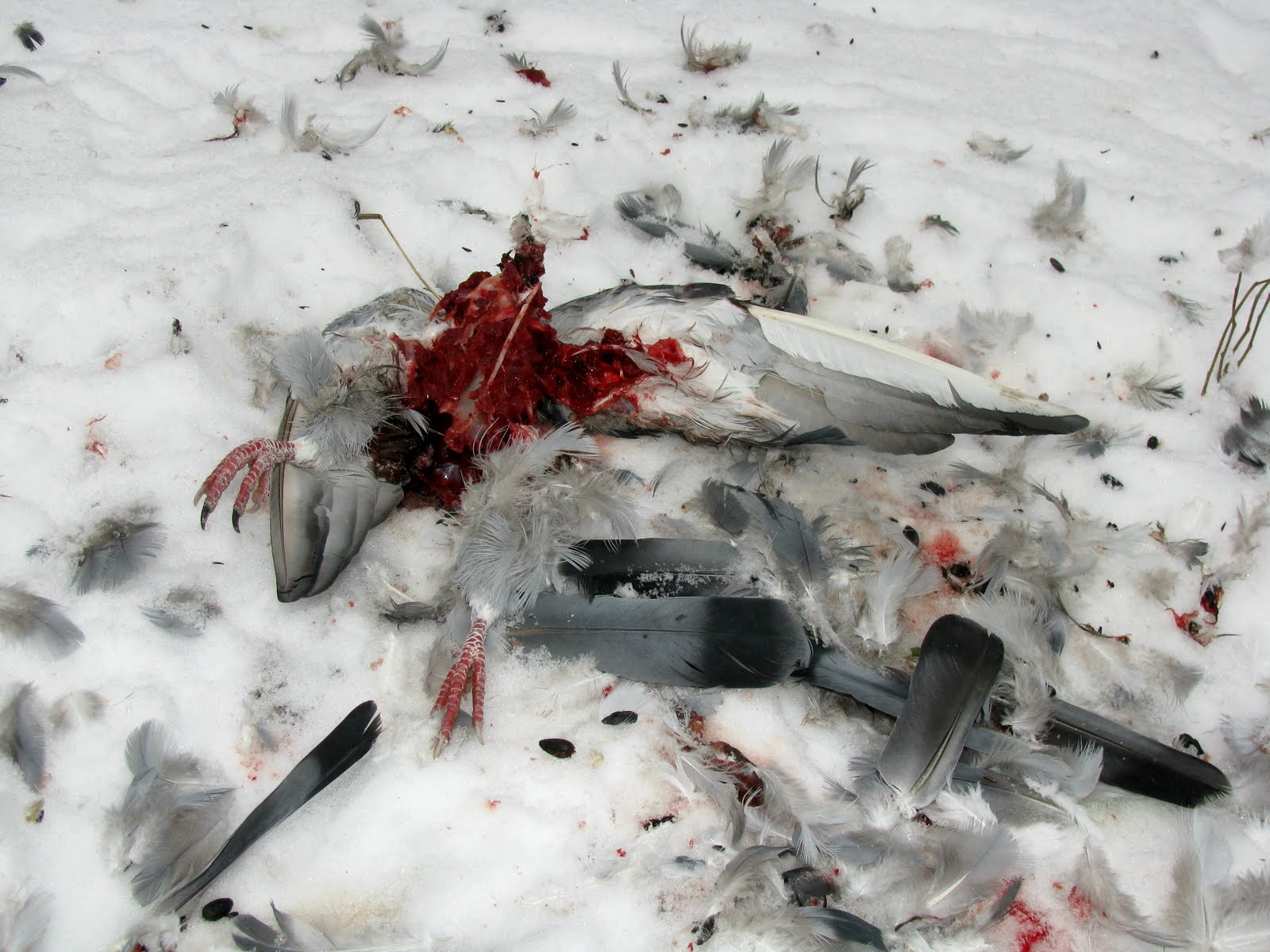
There definitely is at least one Coopers Hawk who has been taking out some Pigeons lately. I don't mind really because Pigeons are a dime a dozen around here. Heck, I can even handle the mess they leave in the aftermath.


A gross sad sighting to some but this is life in the world of the wild. A Hawk only kills what he needs to eat, to survive. If you take the idea that this was a living creature out of your mind for a moment... look at that picture above, such contrast over the snow, the markings on the feathers are quite nice too.

I see more Hawks in my travels too! Mostly Red Tailed Hawks along the highways. On my 19 km trek from work to home, I see 4 every afternoon. Obviously 2 pairs.

I have seen another Red Tail a number of times on Scarlett Road as I get nearer to home. This one is rather bold and doesn't seem to be bothered too much by people in his vicinity. Too many I try to photograph high-tail from me long before I can get a zoom on them.


Last Saturday I was driving along Hwy 427 and counted 9 Hawks (all Red Tails I think) from Derry Road to Hwy 7 which isn't any more than 10 kms or so. Impressive! The thought of slamming on the brakes, jumping out and getting a photo run through my mind; but not such an easy task when driving 105 km/hr.

I snapped this one that seemed to hover just at the top of this hill. I thought I might get an eye-level in-flight shot but when I reached the top of the hill, he was gone.


A little further up the road I spotted this guy sitting at an intersection. I snapped this from my passenger window.


I've noticed a number of American Kestrels in my travels lately too! Three were in an area at the top of Hwy 427 last week. I took this picture through my front windshield before he flew off.


I must add that it's not just the winter when I see Hawks. They are just more visible at this time, to me anyways. All through the year, at any given time, I can have some bird of prey make or try to make a meal of one of my feathered friends. This Sharp Shin Hawk visited a few months back and caught himself a little House Sparrow.


I know a few who get quite upset over the fact of such birds visiting their properties/feeders and making a meal of the birds they feed. While it's never been my intention when backyard bird feeding, and I do my best to keep the feeders in spots with quick escape routes and hide outs... sometimes it just happens that the Hawk is clever and quick enough or a frightened bird goes the wrong way. Luckily for me it's been commoners that show up here in large numbers like House Sparrows, European Starlings and Pigeons who get nabbed. Catching a Blue Jay or Northern Cardinal would be heart-breaking to me since I see not much more than a pair of each.

But not every bird who gets caught, gets eaten. This Sharp Shin has a European Starling in his clutches and we thought he was done for but after a couple minutes of struggle, the Starling broke free and flew off. We sure don't need the television on, just have to look out the kitchen window for a daily story.


So, in your travels, keep your eye to the sky and around you, and you just might see one or a few of these guys along the way. Enjoy them!